A Practical Guide to Document Attestation in the UAE for Businesses
Master the attestation of documents UAE businesses require. This guide explains the process, costs, and common mistakes for commercial and personal documents.
Posted by
 Tadqiq Team
Related Reading
A Practical Guide to E-Invoicing in the UAE
Master e invoicing in UAE. This guide breaks down the PINT AE standard, FTA compliance deadlines, and how to prepare your business for the 2026 mandate.
Read →
A Practical Guide to HS Codes for Dubai Customs & E-Invoicing Compliance
Discover hs codes dubai customs and learn how accurate classifications speed up UAE trade, FTAs, and customs clearance.
Read →
A Guide to TRN Verification FTA for UAE E-Invoicing
Master TRN verification FTA for UAE e-invoicing. Our guide covers manual checks, APIs, and batch validation to ensure VAT compliance and avoid penalties.
Read →
Navigating the legal requirements for operating in the UAE can be complex, and document attestation is a critical hurdle every business must clear. This is the official process of verifying foreign documents, like your company's incorporation certificate or an employee's degree, to make them legally valid within the Emirates. Without this chain of official stamps, your essential paperwork holds no legal weight, leading to operational delays and rejected applications.
This guide provides a clear, practical roadmap for business owners, finance managers, and accountants to manage the attestation process efficiently, ensuring your commercial, educational, and personal documents are accepted by UAE authorities without a hitch.
Why is Document Attestation Non-Negotiable in the UAE?
For businesses in the UAE, document attestation is the bedrock of legal and commercial credibility. It’s the mandatory verification system that confirms your company’s key documents are authentic and trustworthy. UAE government bodies, banks, and free zone authorities rely on this process to prevent fraud and ensure compliance.
This isn't just administrative red tape; it's a foundational requirement for core business activities:
- Company Setup and Licensing: To establish a branch, amend a trade license, or register your company, attested documents like your Memorandum of Association and Certificate of Incorporation are required.
- Employee Visas: Sponsoring a residence visa for an employee, particularly for skilled roles, requires their educational qualifications to be fully attested to be accepted by the Ministry of Human Resources and Emiratisation (MOHRE).
- Banking and Finance: Opening a corporate bank account or securing financing is impossible without attested Powers of Attorney, board resolutions, and trade licenses. For related financial compliance, understanding your TRN number in the UAE is also essential.
- Legal Proceedings: Should you need to enforce a commercial contract in a UAE court, the supporting documents must be properly attested to be considered valid evidence.
The attestation process creates a verifiable chain of trust, starting from a notary in the document's country of origin and culminating with a final stamp from the UAE's Ministry of Foreign Affairs (MoFA). Each stamp validates the one before it, turning a foreign paper into a legally recognized instrument within the UAE.
The Step-by-Step Attestation Journey: From Origin to the UAE
Think of document attestation as a multi-stage journey with mandatory checkpoints. The process is sequential, and skipping a single step will result in your document being rejected, costing you significant time and money. The groundwork begins in the document's home country long before it ever reaches the UAE.
Phase 1: Authentication in the Country of Origin
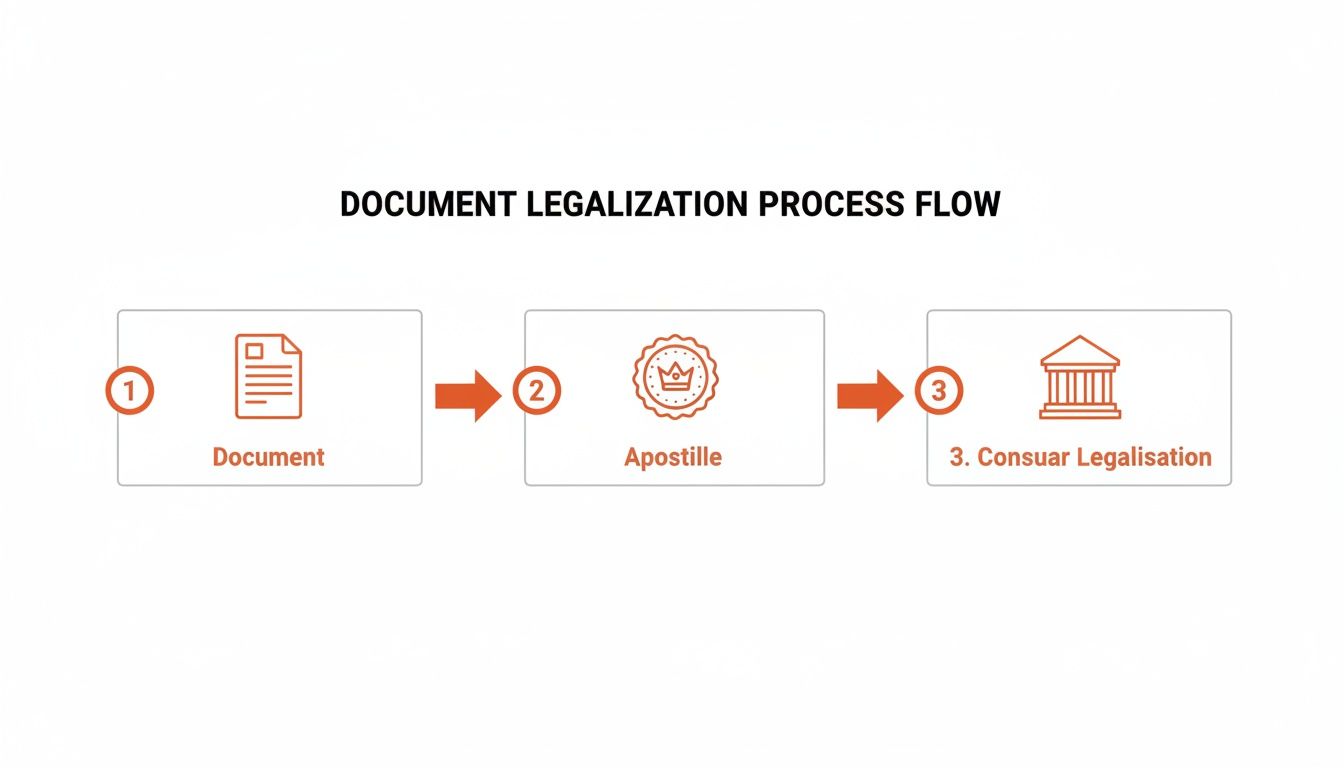
The first leg of the journey involves a series of verifications within the document's home country. While specific authorities may vary, the general workflow is consistent for most non-Hague Convention countries.
The typical steps include:
- Local Notarisation: A Notary Public verifies signatures or certifies a copy as true to the original.
- State/Regional Authority: A higher government body, such as a State Department or Chamber of Commerce, then authenticates the notary's seal.
- Ministry of Foreign Affairs (or equivalent): The country's highest authority adds its stamp, certifying the document for international use.
- UAE Embassy/Consulate: The final step in the home country is getting the document stamped by the UAE's local embassy or consulate. This confirms the document has met all local requirements and is ready for the UAE.
Phase 2: Final Verification in the UAE
Once the document arrives in the UAE with all the necessary stamps from its country of origin, it must undergo one final, crucial step: attestation by the UAE's Ministry of Foreign Affairs (MoFA).
This MoFA stamp is the ultimate seal of approval, making the document legally recognized and usable across all government departments, free zones, and financial institutions in the Emirates. Without it, the document remains legally invalid in the UAE.
Standard Attestation Workflow
| Step | Authority (In Country of Origin) | Authority (In UAE) | Purpose of Verification |
|---|---|---|---|
| 1 | Notary Public / Relevant Issuing Body | N/A | Verifies signatures or confirms the document is a true copy. |
| 2 | State/Regional Government or Chamber of Commerce | N/A | Authenticates the notary or issuing body's authority. |
| 3 | Ministry of Foreign Affairs (or equivalent) | N/A | Certifies the document for international recognition. |
| 4 | UAE Embassy or Consulate | N/A | UAE's official confirmation that home-country checks are complete. |
| 5 | N/A | Ministry of Foreign Affairs (MoFA) | Final stamp that legally validates the document for use in the UAE. |
This structured process ensures every document is meticulously vetted. Getting these procedural details right is vital, much like the precision needed for tax compliance. As companies prepare for new regulations, the importance of accuracy in both physical and digital documentation, such as the upcoming UAE e-invoicing system, cannot be overstated.
A Practical Checklist for Different Document Types
The requirements for attestation vary significantly depending on the type of document. For business owners and finance managers, understanding these differences is key to avoiding common pitfalls. We can group the most common documents into three categories: Commercial, Educational, and Personal.
Attesting Commercial Documents
These documents form the legal backbone of your business operations in the UAE. The attestation process for them is particularly rigorous.
Common commercial documents include:
- Certificate of Incorporation / Incumbency: Proof of your company's legal existence and directorship.
- Memorandum & Articles of Association: Your company's internal constitution and governance rules.
- Board Resolutions: Official records of major corporate decisions, such as opening a branch in the UAE.
- Power of Attorney (PoA): Grants an individual legal authority to act on behalf of the company.
- Commercial Invoices & Certificates of Origin: Essential for import/export and customs clearance.
A key distinction for commercial documents is the frequent requirement for a stamp from the Chamber of Commerce in the country of origin before proceeding to the Ministry of Foreign Affairs. The demand is high; in Q1 2024, the Dubai Chamber of Commerce saw an 11.3% increase in document attestation transactions, as reported on dubaichambers.com, underscoring their importance in the local economy.
Attesting Educational Certificates
Attesting educational certificates is a mandatory step for sponsoring employee visas for most professional roles. This process verifies that your team's qualifications are genuine.
Documents requiring attestation include:
- Degree Certificates (Bachelor's, Master's, PhD)
- Academic Transcripts
- Professional Qualification Certificates (e.g., ACCA, PMP)
Expert Tip: A common delay is obtaining initial verification from the issuing university. Many authorities require a confirmation letter or stamp from the university registrar before the government attestation process can even begin. Start this step early, as it can take several weeks.
Attesting Personal Documents
While often related to employees and their families, these documents are crucial for residency and legal matters.
The most common personal documents include:
- Birth Certificates: Required to sponsor a child's visa.
- Marriage Certificates: Necessary for sponsoring a spouse's visa.
- Divorce Decrees: Needed in specific legal and residency cases.
The process for personal documents typically starts at a vital records office or state department before moving through the standard chain of Ministry of Foreign Affairs and UAE Embassy attestation. Managing these details is just as important as handling other compliance duties. If your team is also navigating tax obligations, our guide on how to register for VAT in the UAE can be a useful resource.
Costs and Timelines: What to Expect
For anyone managing budgets and deadlines, the two most pressing questions are "How much will it cost?" and "How long will it take?" The total cost of attestation is an accumulation of fees from various bodies: the notary, state-level authorities, the home country's Ministry of Foreign Affairs, the UAE Embassy abroad, and finally, the UAE's MoFA fee here in AED.
Estimated Costs and Timelines
The total cost and processing time for attestation of documents UAE requires can vary widely based on the document's origin and type. A personal certificate will have a different cost and timeline than a complex commercial Power of Attorney.
As a general guideline, timelines can range from 1-2 weeks for commercial documents to 4-6 weeks for educational certificates. For a more detailed breakdown, you can review expert guides on embassy attestation procedures and costs. Due to these variables, many businesses opt to use a professional agency to ensure a predictable and timely outcome.
Common Reasons for Rejection (And How to Avoid Them)
Rejections are costly and frustrating, but most are preventable. Here are the most common mistakes to avoid:
- Missing a Stamp: The attestation process is strictly sequential. If a document reaches the UAE Embassy without the stamp from its home country's Ministry of Foreign Affairs, it will be rejected immediately.
- Incorrect Notarisation: Errors such as an expired notary commission or improper legal wording can invalidate the entire process. Always verify your notary's credentials.
- Laminated Documents: Authorities cannot apply stamps to laminated surfaces. If a certificate is laminated, you must obtain a certified true copy to attest instead.
- Outdated Information: Ensure all documents are current. A Power of Attorney with an expired date or a degree with a name that doesn't match a passport will cause issues.
- Wrong Submission Channel: Sending a commercial document to a department that only handles educational certificates is a common error. Ensure you use the correct channel for each document type.
Tadqiq's Advice: Treat each step as a quality control checkpoint. Before sending a document to the next authority, physically inspect it to confirm all previous stamps and signatures are present, clear, and correct. This simple habit prevents the vast majority of rejections.
Insider Tips for a Smoother Attestation Process
For businesses that regularly handle the attestation of documents UAE regulations require, streamlining the process is essential. A few smart strategies can turn a logistical headache into a manageable workflow.

Use Batching and Tracking Systems
If you need to process multiple documents, batching them together is a smart move. Submitting several certificates in one package to the same authority can significantly reduce courier costs and administrative effort.
Complement this with a simple tracking spreadsheet to monitor each document's status. Include columns for the document name, current location, date sent, and the next step. This provides at-a-glance visibility and helps prevent documents from getting lost.
Know When to Outsource to a Professional Agency
The decision to handle attestation in-house versus outsourcing comes down to a cost-benefit analysis. The DIY approach saves on agency fees but consumes valuable staff time that could be spent on core business functions.
Outsourcing to a reputable attestation agency provides peace of mind. These specialists understand the nuances of the bureaucracy, have established relationships, and can often expedite the process. For businesses constantly onboarding employees or managing corporate filings, the efficiency gained by outsourcing almost always outweighs the cost.
This mirrors the importance of verification in tax compliance. Just as accurate data is critical for financial reporting, verified legal documents are non-negotiable for operations. Learning more about processes like FTA TRN verification can offer insights into managing compliance effectively across the board.
Common Questions About UAE Document Attestation
Here are straightforward answers to the most common questions businesses have about the attestation process.
What is the difference between attestation and notarisation?
Notarisation is the first step, where a Notary Public verifies a signature's authenticity on a document in its country of origin. Attestation is the entire multi-step process of international verification, involving government departments and embassies, which culminates in the UAE's Ministry of Foreign Affairs (MoFA) stamp, making the document legally valid in the UAE.
Can a laminated certificate be attested?
No. Lamination prevents officials from applying the required stamps directly onto the document paper. Laminated certificates are always rejected. You must either have the lamination professionally removed or obtain a certified true copy for attestation.
How long is a UAE attestation valid for?
The attestation stamp from MoFA itself does not expire. However, the content of the document may have its own validity period. For example, a Power of Attorney may specify an end date, and a police clearance certificate is typically only valid for a few months.
Do documents need to be translated into Arabic?
If your document is not in Arabic or English, you will need to have it legally translated by a certified legal translator in the UAE. This translated copy must then often be verified by the UAE's Ministry of Justice before it can be used for official purposes. This precision is critical, similar to the accuracy required for financial compliance, which you can learn more about in our guide on what is VAT in the UAE.
Ready to streamline your e-invoicing? Try Tadqiq today at tadqiq.ae.