Small Business Relief UAE Corporate Tax: A Practical Guide for SMEs
Learn how small business relief uae corporate tax works, eligibility, the AED 3 million threshold, and how to claim it for your UAE business.
Posted by
 Tadqiq Team
Related Reading
A Practical Guide to E-Invoicing in the UAE
Master e invoicing in UAE. This guide breaks down the PINT AE standard, FTA compliance deadlines, and how to prepare your business for the 2026 mandate.
Read →
A Practical Guide to HS Codes for Dubai Customs & E-Invoicing Compliance
Discover hs codes dubai customs and learn how accurate classifications speed up UAE trade, FTAs, and customs clearance.
Read →
A Guide to TRN Verification FTA for UAE E-Invoicing
Master TRN verification FTA for UAE e-invoicing. Our guide covers manual checks, APIs, and batch validation to ensure VAT compliance and avoid penalties.
Read →
Navigating the UAE's new Corporate Tax landscape can seem complex, but there's a crucial piece of good news for small businesses and startups. It’s called Small Business Relief, a lifeline from the Federal Tax Authority (FTA) designed to support your growth.
Simply put, if your business earns AED 3 million or less in revenue during a tax period, you can elect to be treated as having zero taxable income. This means your corporate tax bill for that period is effectively nil, freeing up vital cash for reinvestment.
What is Small Business Relief?
Think of Small Business Relief as essential breathing room for your company. It’s designed to let you put money back into growing your business instead of paying the standard 9% corporate tax. This isn't a loophole; it's a strategic policy outlined in Article 21 of the Federal Decree-Law No. 47 of 2022, aimed squarely at supporting the backbone of the UAE's economy—its small and medium-sized enterprises.
However, this benefit is not automatic. You must actively elect for it when you file your annual corporate tax return. Making this choice can significantly simplify your tax compliance, but it's a decision that requires careful consideration.
Key Features of the Relief
The core purpose of this relief is to ease the administrative and financial pressure on smaller businesses. It allows you to focus on innovation and expansion rather than complex tax calculations.
Here are the main features to understand:
- Zero Taxable Income: If your business revenue is AED 3 million or less, the FTA considers your taxable income to be zero for that period.
- Simplified Compliance: You can skip complex calculations for taxable income, deductions, and exemptions, which means less paperwork and stress.
- Mandatory Election: This is critical. You must formally opt-in for the relief on your corporate tax return. Forgetting to do so means you miss out on the benefit for that period.
This relief was enhanced in April 2023 when Ministerial Decision No. 73 raised the revenue threshold from a previously proposed AED 375,000 to the current AED 3 million. This change applies to tax periods starting on or after 1 June 2023 and is set to run until 31 December 2026, providing vital support for startups, freelancers, and small businesses across the Emirates. You can read more about the initial announcement on Wamda.
To give you a quick, at-a-glance summary, here are the key details of the Small Business Relief programme.
Small Business Relief at a Glance
| Attribute | Details |
|---|---|
| Eligibility Threshold | Gross revenue must not exceed AED 3 million in the relevant tax period. |
| Key Benefit | Taxable income is treated as zero, resulting in AED 0 corporate tax liability. |
| How to Claim | Must be formally elected on the annual Corporate Tax return. It is not automatic. |
| Effective Period | For tax periods starting on or after 1 June 2023, and ending before or on 31 December 2026. |
| Legal Basis | Article 21 of Federal Decree-Law No. 47 of 2022 and Ministerial Decision No. 73 of 2023. |
| Important Note | Does not exempt a business from the requirement to register for and file Corporate Tax returns. |
This table helps put the most important facts front and centre, but always remember to look at the finer details as they apply to your specific business situation.
It's also crucial to understand that this relief is completely separate from your other tax duties. For example, it doesn’t change your VAT obligations one bit. If you need a refresher, check out our guide on what VAT is in the UAE to make sure you’re staying fully compliant across the board.
Who Qualifies for Small Business Relief?
Before planning around the small business relief for UAE corporate tax, you must be certain your business is eligible. The Federal Tax Authority (FTA) has set clear criteria to ensure this relief targets genuine small businesses, and misinterpreting the rules can lead to compliance issues.
First, your business must be a resident taxable person. This official term simply means you are an individual conducting business in the UAE (like a freelancer or sole proprietor) or a legal entity established, managed, and controlled from within the country.
The Critical Revenue Threshold
The most significant eligibility factor is your annual revenue. To qualify, your total revenue must be AED 3 million or less for the relevant tax period.
Crucially, this is not a one-time check. You must have remained below the AED 3 million threshold in the current tax period and all previous ones. If your revenue exceeds this limit even once, your business becomes permanently ineligible for the relief, even if your sales fall below AED 3 million in a subsequent year.
This flowchart breaks down the basic decision pretty clearly.
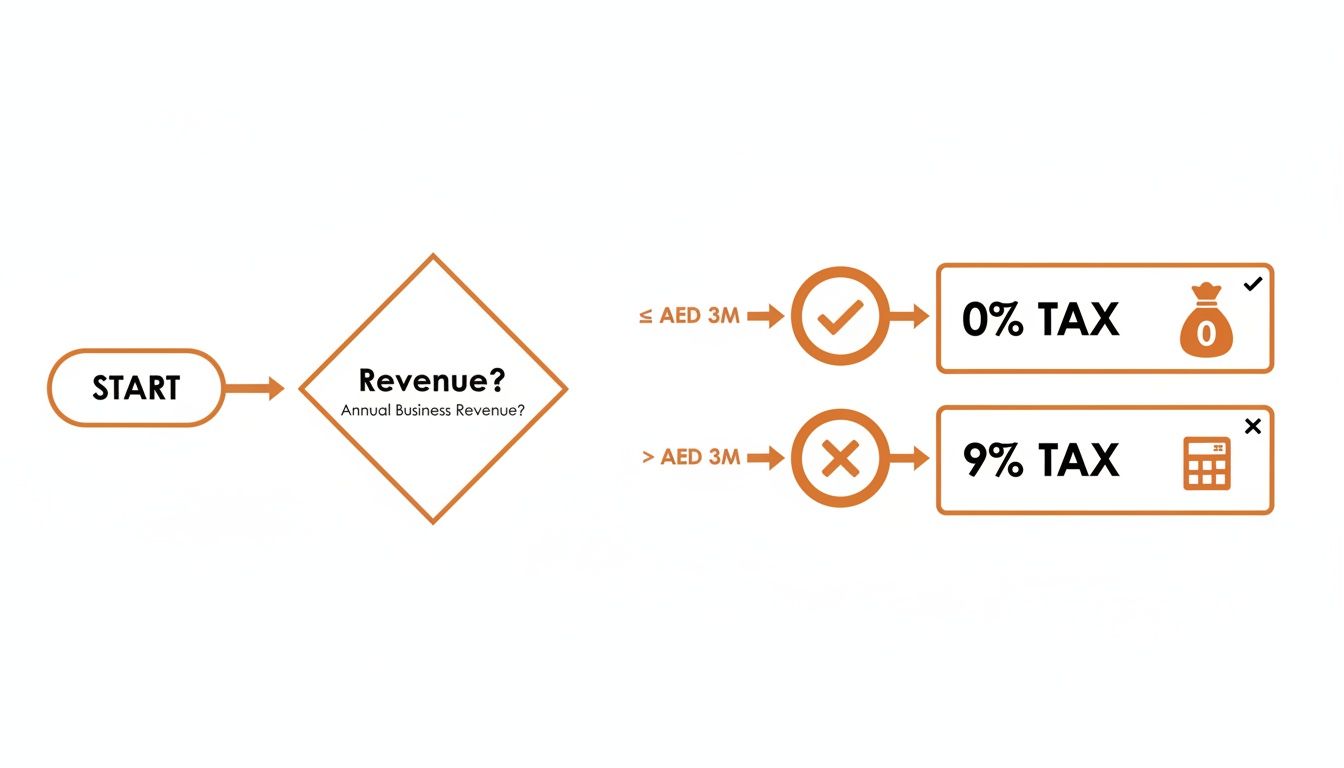
As you can see, keeping your revenue below that AED 3 million line is the key that unlocks the 0% corporate tax rate through this relief.
Who is Automatically Disqualified?
Beyond the revenue cap, certain types of businesses are automatically excluded, regardless of their turnover. Understanding these exclusions is just as important as tracking your sales figures.
You are not eligible for Small Business Relief if your business is:
- A Qualifying Free Zone Person (QFZP): If you already benefit from the 0% corporate tax rate on your qualifying income due to your Free Zone status, you cannot also claim this relief.
- Part of a Multinational Enterprise (MNE) Group: If your company is part of a large multinational group with consolidated global revenues exceeding AED 3.15 billion, you will not qualify. The FTA assesses the entire group's revenue, not just your local entity's.
- An Artificially Separated Business: The FTA has implemented anti-abuse rules to prevent businesses from being artificially split into smaller entities solely to meet the AED 3 million threshold. If this is identified, all related entities will be disqualified.
Finally, remember that you don't receive this relief automatically. You must elect to apply for it when filing your corporate tax return. This also means you must be properly registered for corporate tax and have a Tax Registration Number (TRN). The process shares similarities with VAT registration, so if you're new to the tax system, our guide on how to register for VAT in the UAE can be a helpful starting point.
The Financial Impact of Small Business Relief
Understanding the rules is important, but what truly matters is the impact on your company's bottom line. This relief translates into real, tangible savings that improve cash flow and provide more capital for reinvestment and growth.
Let's consider a practical example. Imagine a Dubai-based consultancy with AED 2.5 million in annual revenue and a taxable profit of AED 500,000. Without this relief, you would calculate your corporate tax liability based on that profit. By simply electing for Small Business Relief, your tax bill for that period drops to zero, freeing up significant cash.

Calculating the Savings
To put concrete numbers on this, consider another common scenario for a growing SME. Your business generates AED 1.5 million in revenue and has a taxable income of AED 1.125 million.
Ordinarily, you'd be looking at a hefty tax bill. But with the relief, you completely erase what would have been a AED 67,500 tax payment (calculated at 9% on the AED 750,000 that sits above the AED 375,000 zero-rated threshold). That AED 67,500 is now yours to keep for operations, expansion, or a much-needed cash buffer.
Key Strategic Considerations
While the immediate financial benefit is compelling, opting for the relief involves strategic trade-offs that you need to consider carefully. The most significant is forfeiting certain tax provisions that could be valuable in the future.
When you elect for Small Business Relief, you can no longer:
- Carry Forward Tax Losses: If your business has a loss-making year while claiming the relief, you cannot carry that loss forward to reduce taxable profits in future, more profitable years.
- Claim Specific Deductions: Because the relief treats your taxable income as zero, you won't calculate it in the first place. This makes deductions for business expenses irrelevant for that tax period.
- Utilise Group Relief Provisions: Companies claiming the relief cannot form or be part of a tax group, which would otherwise allow them to balance profits and losses with related entities.
This forces a calculated decision, especially for startups that often operate at a loss in their early years. You are essentially trading the certainty of zero tax today for the potential benefit of using current losses to offset future profits.
This decision is a core part of your long-term financial strategy. If you’re forecasting rapid growth that will push your revenue over the AED 3 million threshold soon, it might make more sense to preserve those tax losses rather than take the immediate relief.
And one last, crucial point: this relief has absolutely no bearing on your VAT obligations. VAT and corporate tax are two separate regimes. For a refresher on your responsibilities, you can check out our guide on how to calculate VAT in the UAE.
How to Claim the Relief and Maintain Compliance
Knowing you're eligible for Small Business Relief is the first step, but the benefit is not granted automatically. You must actively claim it through the proper channels.
To receive the benefit, you must make an election for it when filing your annual corporate tax return with the Federal Tax Authority (FTA). If you miss this crucial step, you lose the opportunity for that tax period.
The process begins with registering for corporate tax and obtaining a Tax Registration Number (TRN). Then, when completing your annual filing on the EmaraTax platform, you must formally select the option to apply for Small Business Relief. This action informs the FTA that your revenue is below the AED 3 million threshold and you are choosing to have your taxable income treated as zero.
Simplified Record-Keeping, Not No Record-Keeping
One of the most practical benefits of claiming the relief is the simplification of your accounting requirements. Businesses that qualify are permitted to prepare their financial statements using a cash basis of accounting. For most small companies, this is a much more straightforward method than accrual accounting and can significantly reduce administrative time.
However, "simplified" does not mean "no" accounting.
Maintaining accurate and complete financial records is absolutely non-negotiable. The FTA reserves the right to request proof of your revenue at any time to verify your eligibility for the relief you claimed.
You must be prepared to provide clear documentation upon request, including:
- Invoices and Receipts: Every sales invoice and business expense receipt must be securely stored and organised.
- Bank Statements: Your business bank statements are crucial for confirming transactions and validating your revenue figures.
- Contracts and Agreements: Key documents detailing your sources of income should be properly filed and accessible.
The core principle is straightforward: while the relief makes your tax calculation zero, your duty to prove your revenue figures doesn't disappear. Flawless records are your best defence against any potential FTA audit.
Ultimately, keeping meticulous financial records is just good business practice and a cornerstone of compliance, relief or no relief. This diligence is also essential preparation for what’s coming next. You can get ahead by reading our guide to UAE e-invoicing. Proper documentation ensures you're ready for any scrutiny and can confidently claim the benefits you're entitled to.
Balancing Relief with VAT and E-Invoicing Compliance
While eligibility for the small business relief for UAE corporate tax is a significant advantage, it is crucial to understand that it does not create a bubble around your other tax duties. This relief is specifically for corporate tax and has no impact on your Value Added Tax (VAT) obligations.
If your business is registered for VAT, you must continue to comply fully. This includes issuing proper tax invoices, filing your VAT returns on schedule, and remitting any tax due to the Federal Tax Authority (FTA). The two tax systems are entirely separate, and confusing them is a common and potentially costly mistake.
The Link to E-Invoicing Compliance
This separation of tax duties highlights the importance of accurate record-keeping, especially with the UAE's mandatory e-invoicing system on the horizon. Every transaction that contributes to your revenue must be documented perfectly, both for current VAT compliance and for future verification of your corporate tax relief eligibility.
Since its introduction in June 2023, Small Business Relief has been a game-changer for over 90% of the UAE's smaller companies. It essentially allows businesses with revenue under the AED 3 million cap to sidestep corporate tax until the end of 2026. This breathing room, however, demands even more precision in your invoicing. Tools like Tadqiq can turn this into an advantage by running pre-submission checks, ensuring every invoice is 100% FTA-compliant and meets data protection standards. If you want to dig deeper, you can read the full report from Deloitte for more insights.
Why Perfect Invoicing is Non-Negotiable
Once the UAE e-invoicing mandate is implemented, every invoice must conform to the strict PINT AE standard. An invoice that appears correct to your customer could be instantly rejected by the FTA's system due to simple errors like a typo in a Tax Registration Number (TRN) or a formatting issue.
This creates two major challenges for businesses claiming the relief:
- Delayed Payments: A rejected e-invoice is not a valid invoice, which can seriously disrupt your cash flow while you fix and resubmit it.
- Inaccurate Revenue Records: Rejected or poorly formatted invoices compromise your financial records, making it extremely difficult to prove your revenue is under the AED 3 million threshold during an FTA audit.
Think of meticulous invoicing as your best line of defence. It keeps you compliant with current VAT laws while building a solid, auditable paper trail that proves you qualify for corporate tax relief.
This is where a validation platform like Tadqiq becomes an essential safety net. It vets each e-invoice against FTA requirements before it is sent, catching errors like invalid TRNs or incorrect codes. You can learn more about the importance of a valid TRN number in our detailed guide. This proactive step helps you build a clean, verifiable financial history that satisfies both your VAT and corporate tax obligations.
Preparing for a Future Beyond the Relief
The small business relief for UAE corporate tax is a valuable opportunity, but it is important to remember that it has an expiry date. The relief is currently scheduled to apply only to tax periods ending on or before 31 December 2026. This deadline should be viewed not as a threat, but as a strategic window to strengthen your financial operations.
Think of this period as a government-supported runway for your business. The cash you save by not paying corporate tax now is the perfect capital to invest in building a rock-solid financial foundation. A proactive approach will ensure your business is not just ready to survive the transition to the standard 9% rate, but positioned to thrive.
Building Your Post-Relief Strategy
Your focus during this time should be on creating robust systems and instilling financial discipline that will serve you well long after 2026. Waiting until the last minute will make the sudden shift to paying tax a shock to your cash flow.
Here are key actions you should be taking right now:
-
Implement a Strong Accounting System: If you have been using simple spreadsheets or cash-basis accounting, now is the time to upgrade. Transitioning to a proper accrual-based system provides a much clearer picture of your company's true financial health and prepares you for standard tax calculations.
-
Master Financial Forecasting: Develop the habit of building detailed financial forecasts. This is not just about predicting revenue; it's about modelling exactly how a 9% tax will impact your cash flow, pricing strategy, and profitability. This allows you to make smart adjustments well in advance.
-
Explore Tax Planning Opportunities: Begin consulting with a tax advisor to understand the standard corporate tax rules. You can start investigating legitimate deductions, allowances, and tax grouping options that may become available once you are no longer claiming the relief.
The smartest businesses are treating this relief period like a training ground. Use these tax-free years to professionalise your financial operations. That way, the eventual transition to paying the standard tax rate is just a manageable next step, not a disruptive leap.
By taking these steps now, you can ensure the end of the small business relief for UAE corporate tax doesn't catch you off guard. Instead, you'll be perfectly positioned for sustained growth in the UAE's evolving tax environment.
Your Questions Answered
When it comes to the new small business relief for UAE corporate tax, many questions arise. As this is a new system, the details are important. Let's address some of the most common queries from business owners and accountants.
Can a Free Zone Business Claim This Relief?
This is a common point of confusion, and the answer is: it depends on your status.
If your company is a 'Qualifying Free Zone Person' (QFZP) and already benefits from the 0% tax rate on your qualifying income, you cannot also claim Small Business Relief. You must choose one benefit or the other.
However, if you operate a business in a free zone but have not elected to be treated as a QFZP, you may still be eligible. As long as you meet the other conditions—especially the AED 3 million revenue cap—you can claim the relief.
What if My Revenue Exceeds AED 3 Million Just Once?
This is one of the most critical rules to understand. The moment your revenue exceeds AED 3 million in any tax period starting on or after 1 June 2023, you lose eligibility for Small Business Relief—permanently.
This is not a temporary suspension. Even if your revenue falls below the threshold in subsequent years, the opportunity to claim the relief is gone for good. Once you cross that line, you are subject to the standard corporate tax regime from that point forward.
Do I Still Need to File a Tax Return if I Claim the Relief?
Yes, absolutely. This relief is a significant benefit, but it is not an exemption from your filing obligations. Every taxable business in the UAE must file an annual corporate tax return with the Federal Tax Authority (FTA), even if no tax is due.
Think of it this way: you don't automatically get the relief just by being eligible. You must formally elect to take it, and you do that within your annual tax return. If you don't file, you can't claim.
Ready to streamline your e-invoicing and ensure flawless tax records? Tadqiq validates every invoice against FTA standards before submission, giving you complete compliance confidence.